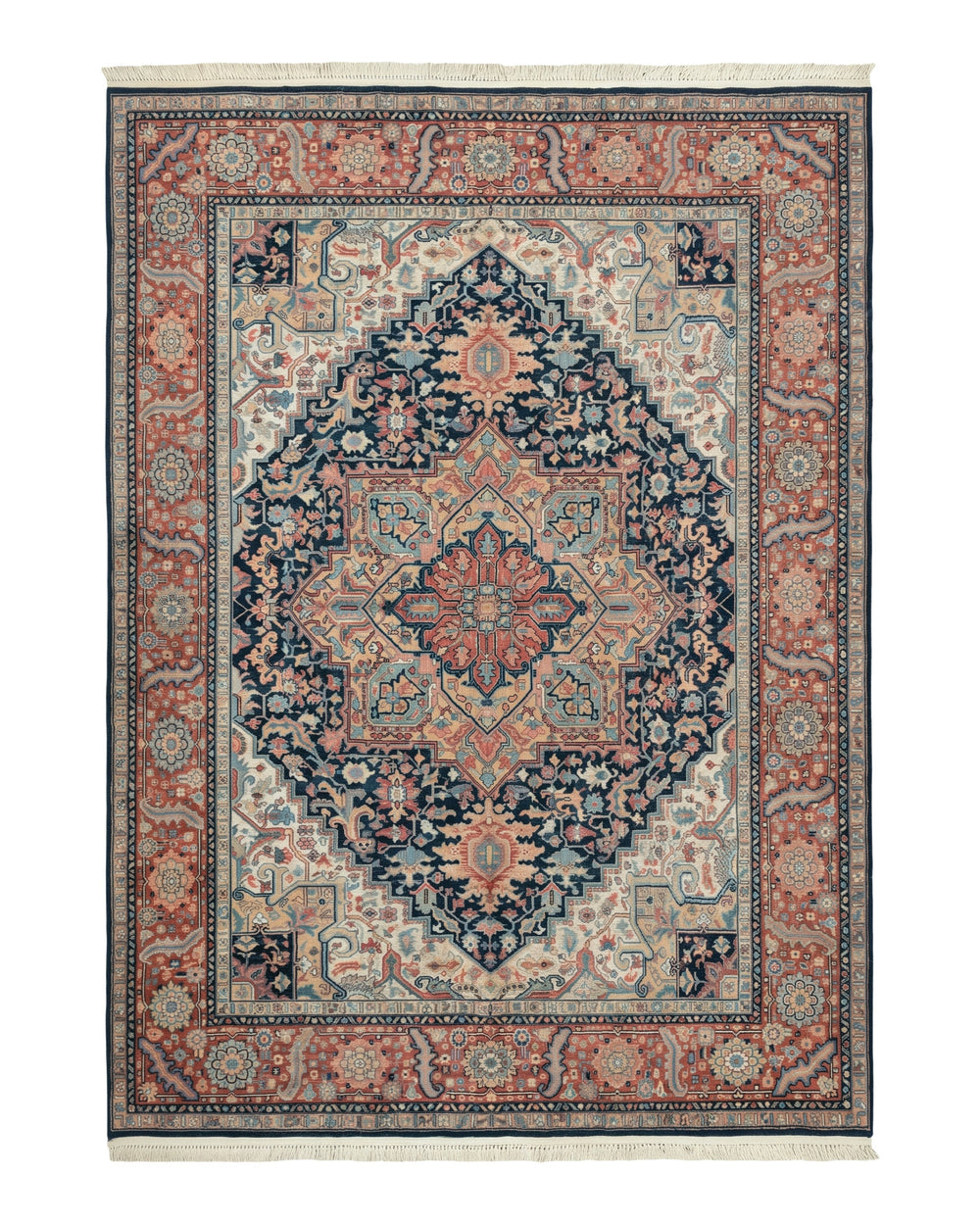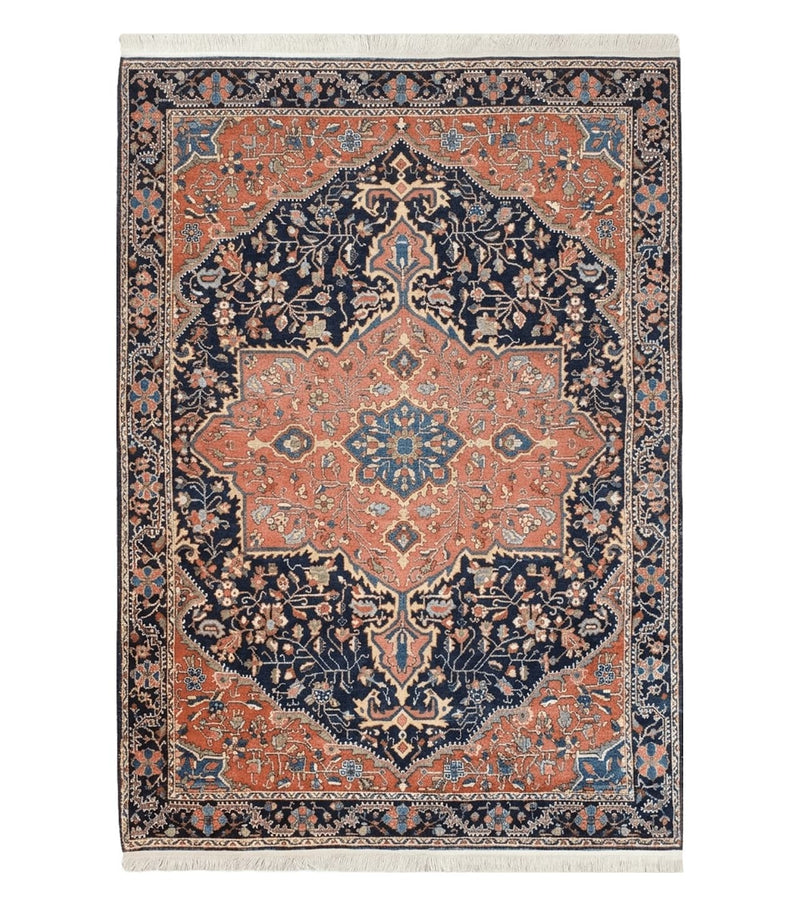


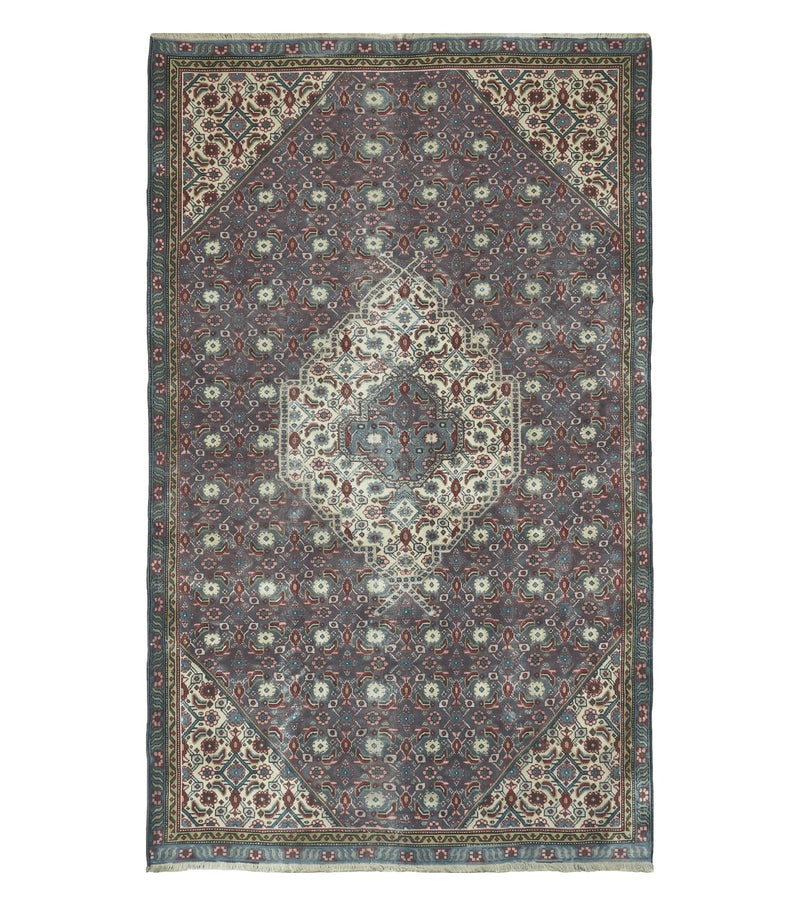


Where most Karastan designs are floral and flowing, the Heriz designs are bold and geometric. They follow the village rugs of the Heriz area in northwest Iran, with large angular medallions and strong, architectural drawing. Karastan's Heriz designs bring that sturdy, handsome look to its durable worsted wool, and they suit rooms where a floral rug would feel too formal.
| Collection | Original Collection (700 Series) |
|---|---|
| Designs | #700/701 Navy Heriz, #726 Heriz, #748 Blue Heriz |
| Inspired by | Heriz and Serapi village rugs of northwest Iran |
| Style | Geometric medallions with angular drawing |
#700/701 Navy Heriz
The Navy Heriz is the best known of the group. Its label often reads 700/701, sometimes shortened to #701. It sets a geometric design on a deep navy ground, a striking contrast with the red and ivory of most Karastans.
#726 Heriz and #748 Blue Heriz
The #726 Heriz and the #748 Blue Heriz follow the same geometric tradition. Both are sometimes described as "Heriz Serapi," reflecting the close link between the two styles. The #748, with its blue tones, is less common than the red-ground designs.
The Persian Heriz connection
Heriz rugs are woven in villages on the slopes of Mount Sabalan in Iranian Azerbaijan. They are known for large geometric medallions, bold corner pieces, durable wool and a sturdy weave. The finest older examples are often called Serapi. Because they are woven largely from memory rather than from detailed drawings, their designs are angular rather than curved. See Heriz Rugs and Geometric vs. Curvilinear Designs.
Heriz and Serapi in the 700 Series
Karastan made a separate group of Serapi designs, including the #736 Medallion Serapi. The two groups are closely related, and the dividing line between them is not always sharp. See Karastan Serapi Rugs.