



Rug descriptions use a vocabulary of their own, drawn from Persian, Turkish and the language of the trade. This glossary explains the terms you are most likely to meet, with links to fuller entries where they exist. For the parts of a rug, see also Anatomy of a Rug.
A to C
- Abrash: visible bands of slightly different shade within one color, caused by batches of hand-dyed wool. See Natural vs. Synthetic Dyes and Abrash.
- All-over design: a pattern that repeats across the whole field without a central medallion. See All-Over Designs.
- Aniline dye: an early synthetic dye of the late 19th century; some faded or ran.
- Antique: in the rug trade, a rug about 100 years old or more. See Antique, Semi-Antique and Vintage Rugs.
- Asymmetric knot: the Persian or Senneh knot, wrapped around one warp and passed behind the next. See Knots and Knot Density.
- Boteh: the teardrop or paisley motif. See The Boteh (Paisley) Motif.
- Cartoon: a design drawn on squared paper, each square standing for one knot; used in city workshops. In Persian, naqsheh.
- Cartouche: a framed panel holding a signature, date or inscription. See Signed Rugs.
- Chrome dye: the stable synthetic dyes widely used from the mid-20th century.
- City rug: a rug woven in an urban workshop from a drawn design. See City, Village and Tribal Rugs.
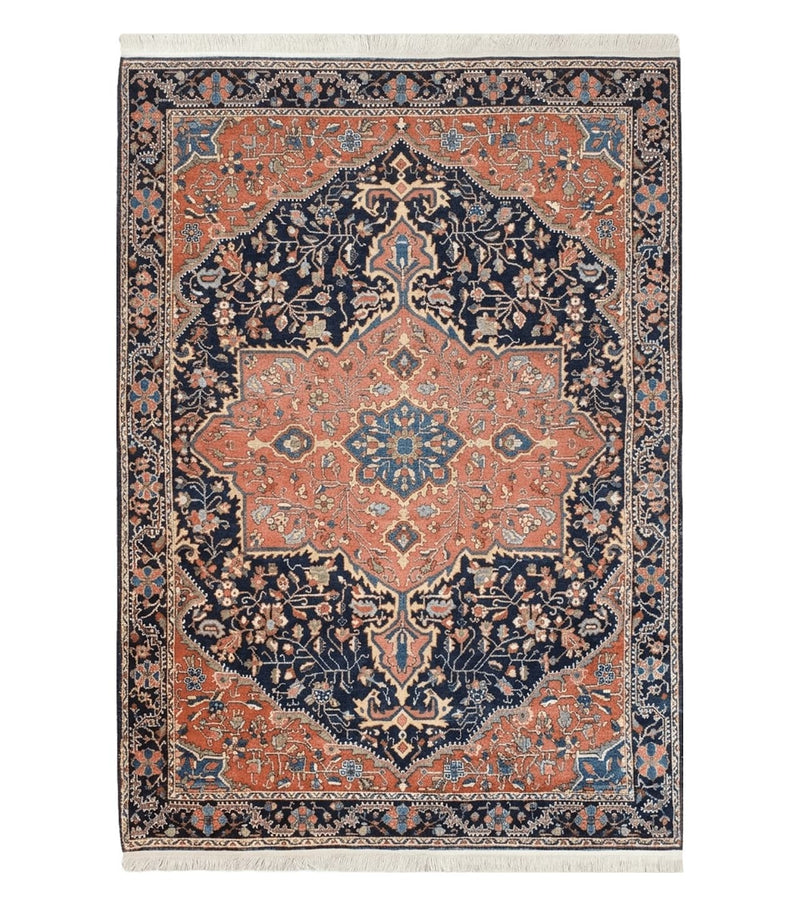
- Corner pieces (spandrels): quarter-designs that fill the corners of the field, usually echoing the medallion.
D to H
- Dozar: a rug of about 4 × 6 to 4½ × 7 feet; literally "two zars." See Rug Sizes Explained.
- Field: the main area of the rug inside the borders.
- Flatweave: a rug without pile, such as a kilim or soumak. See Flatweaves vs. Pile Rugs.
- Foundation: the warps and wefts that make up the body of the rug.
- Fringe: on a hand-knotted rug, the ends of the warp threads.
- Gabbeh: a thick, coarsely knotted tribal rug with simple designs. See Gabbeh Rugs.
- Guard stripe: a narrow border on either side of the main border.
- Gul: a polygonal motif repeated across Turkmen and Bokhara rugs.
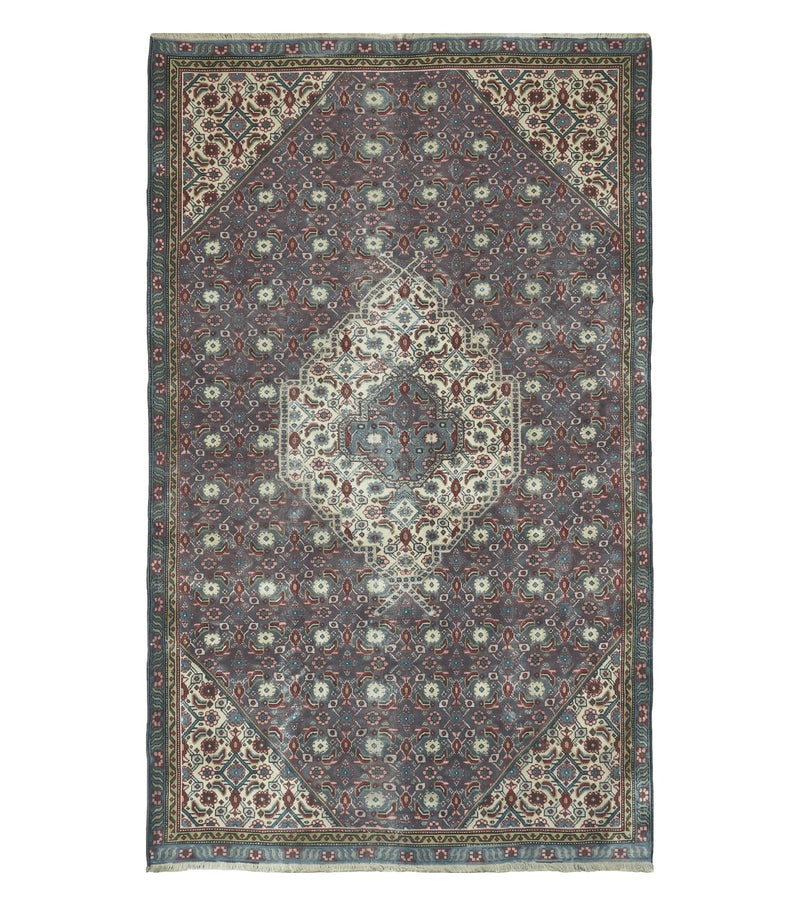
- Herati: an all-over pattern of a rosette within a diamond, flanked by curling leaves; also called mahi (fish) in its small form.
J to M
- Jufti knot: a "false" knot tied around four warps instead of two, which halves the work and the density.
- Kelleh: a long rug, wider than a runner, often about 6 to 7 feet wide and twice as long or more.
- Kilim: a slit-tapestry flatweave. See Kilim Rugs.
- Kork: fine wool from the neck and shoulders of the sheep. See Rug Materials.
- KPSI: knots per square inch, the usual measure of knot density.
- La: a grading used for Nain rugs, from the number of strands in the warp; 4 la is finer than 9 la. See Nain Rugs.
- Medallion: a large central motif in the field. See Medallion Designs.
- Mihrab: the arch shape at one end of a prayer rug. See Prayer Rugs.
- Mina Khani: an all-over lattice of flowers linked by vines.
N to R
- Nap: the direction the pile leans. A rug looks lighter viewed with the nap and darker against it.
- Open field: a field left largely plain, without an all-over pattern.
- Overcasting: yarn wrapped around the outer warps to finish the sides.
- Palmette: a stylized flower seen in cross-section, common in borders and fields.
- Patina: the soft sheen and mellowed color of an old rug.
- Pendant: a small motif at each end of a medallion.
- Pile: the soft surface formed by the cut ends of the knots.
- Raj: the Tabriz grading of knots across 7 centimeters. See Tabriz Rugs.
- Runner: a long, narrow rug for halls and stairs.
S to Z
- Selvedge: the finished long sides of the rug.
- Semi-antique: a rug roughly 50 to 100 years old.
- Shah Abbasi: a family of palmette designs named after the Safavid ruler Shah Abbas.
- Soumak: a flatweave made by wrapping wefts around the warps.
- Symmetric knot: the Turkish or Ghiordes knot, wrapped around two warps with both ends coming up between them.
- Tribal rug: a rug woven by nomadic or semi-nomadic people. See Persian Tribal Rugs.
- Village rug: a rug woven at home in a village, usually from memory. See Persian Village Rugs.
- Warp: the threads running the length of the rug, around which the knots are tied.
- Weft: the threads running across the rug between rows of knots.
- Zar: a traditional Persian measure of roughly 3½ feet (about 104 centimeters), used in size names such as dozar.
- Zil-i-sultan: a design of repeated vases of flowers, often with birds, named after a Qajar prince.
Many motifs have their own stories, explained in Rug Motifs and Their Meanings.