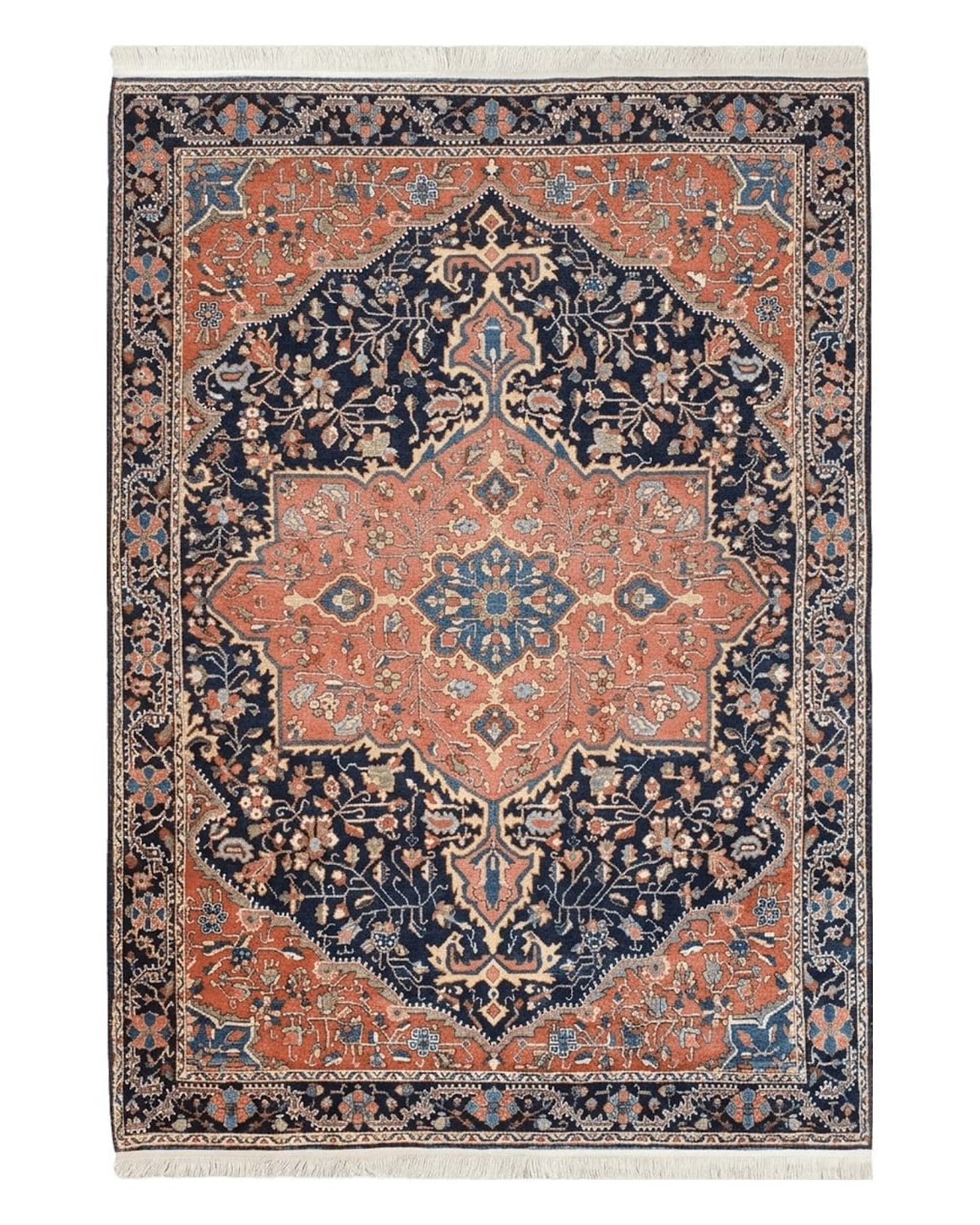
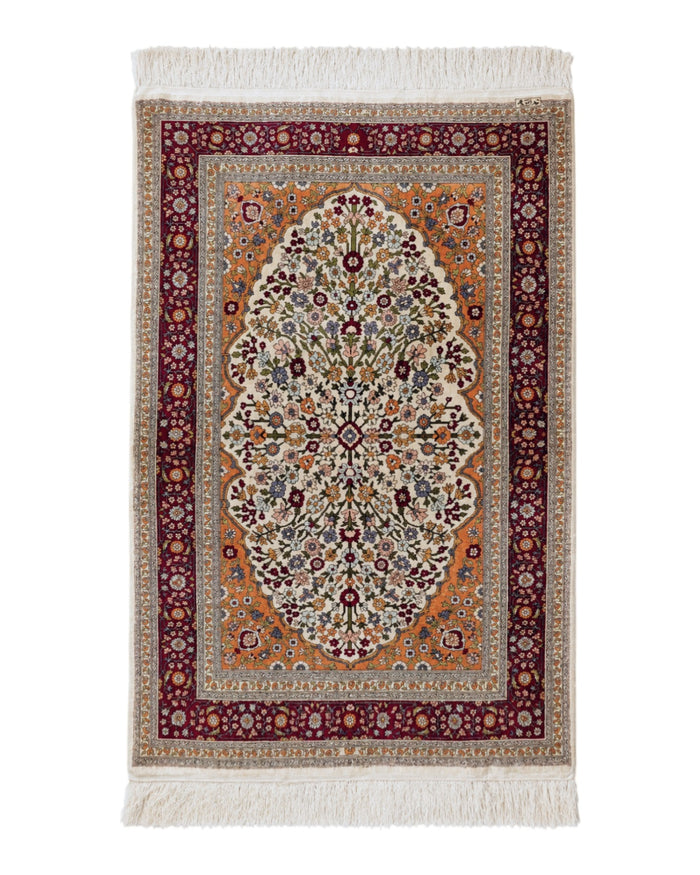
Most handmade rugs carry no label and no date, so their age has to be worked out from the rug itself. Experienced dealers look at many clues together: the design, the colors and dyes, the wool, the way the rug was constructed, and how it has worn. Each clue narrows the range, which is why rugs are usually dated to a decade or a span, such as "circa 1920s" or "mid-20th century," rather than to a single year.
| Main clues | Design, dyes, materials, construction, wear and repairs |
|---|---|
| Woven dates | Uncommon; usually in Persian numerals and the Islamic calendar |
| Typical precision | A decade or a span of a few decades |
| Rough guide | Antique: about 100+ years; semi-antique: about 50 to 100 |
Design and style
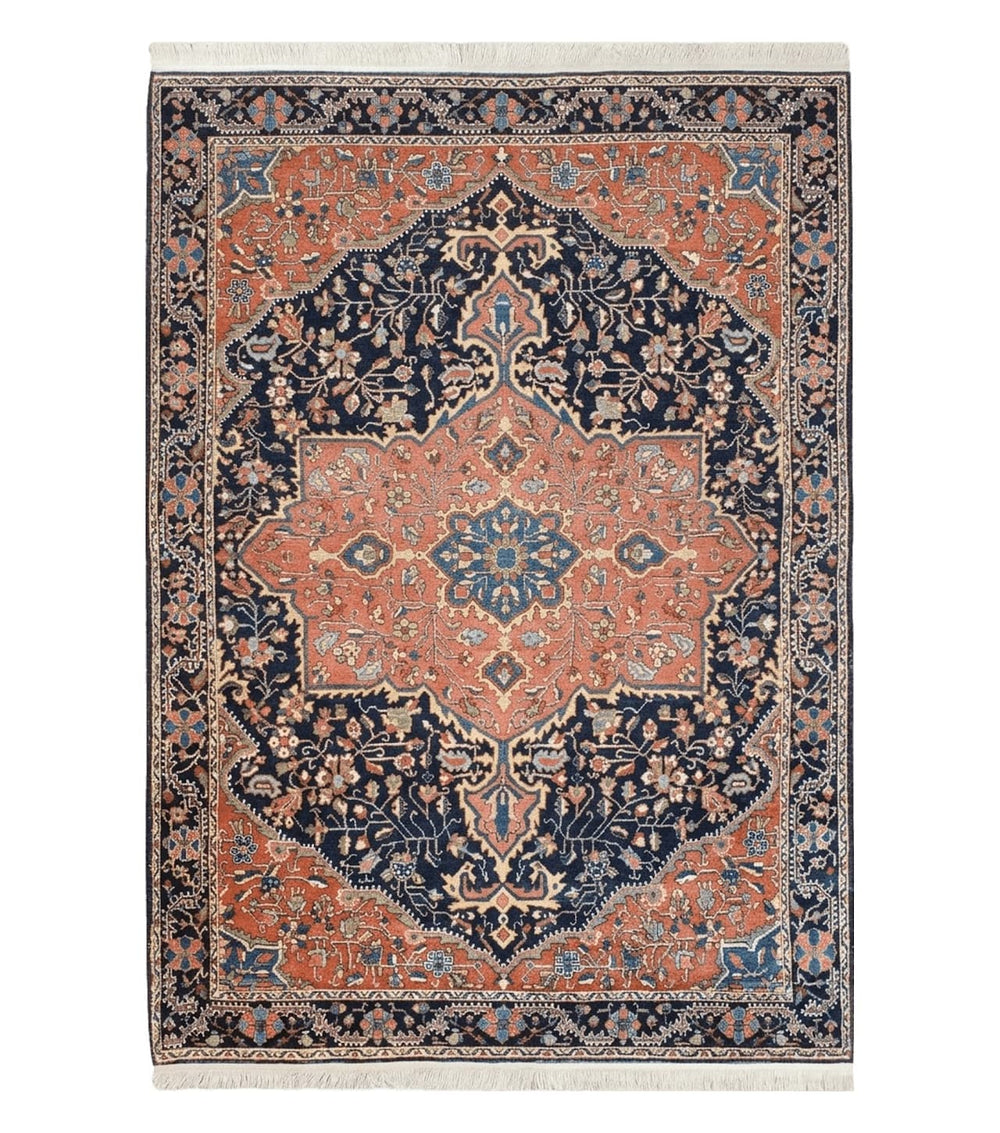
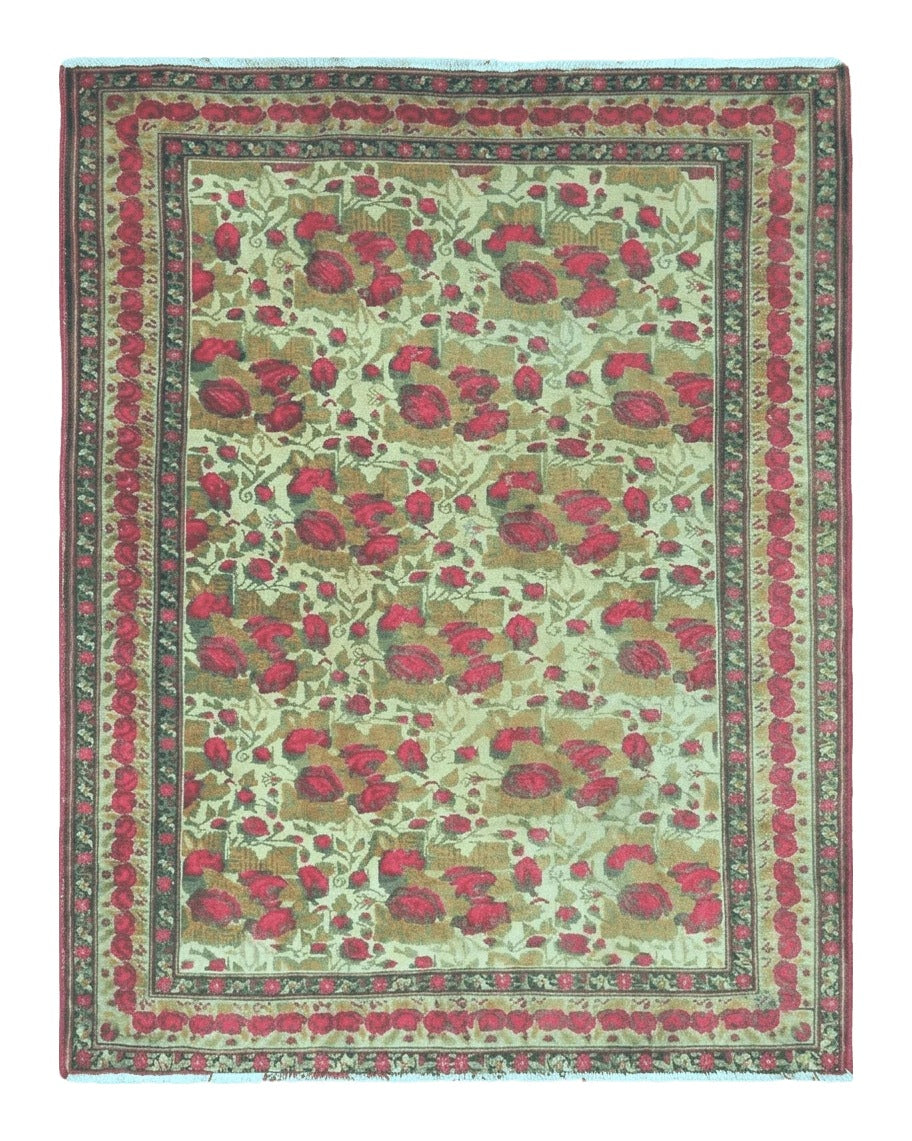
Weaving styles change over time, like fashions in anything else. Designs woven for the American market in the 1920s to 1950s, such as the "American Sarouk" with its rose-red field and floating floral sprays, belong to a particular period. Older village rugs often have more archaic, freely drawn designs, while later pieces tend to be more standardized. Knowing how a region's designs developed is one of the strongest dating tools.
Colors and dyes
Natural dyes were the only option until synthetic dyes arrived in the later 19th century. Early synthetic dyes, some of which faded or ran in characteristic ways, point to the late 19th or early 20th century. The stable chrome dyes in wide use by the mid-20th century point to later rugs. See Natural vs. Synthetic Dyes and Abrash.
Materials
Hand-spun wool, slightly uneven and with a natural luster, was standard in older rugs. Machine-spun wool became more common through the 20th century. Changes in foundation materials are also useful: some tribes switched from wool to cotton warps over time, and the type of cotton, hand-spun or machine-spun, can help too.
Construction
How the sides and ends were finished, how many wefts were used between rows of knots, and how the rug was woven all change slowly over time within each region. A specialist who has handled many rugs of one type can often place a piece within a few decades from its back alone. See Anatomy of a Rug.
Wear, patina and repairs
Age brings an even, gentle wear to the pile, a softening of colors, and a soft sheen called patina. Older rugs may also show careful old repairs. Wear must be read with care, though: a rug that has been in heavy use for twenty years can look more worn than a century-old rug that was kept in a quiet room, and some rugs are deliberately washed or sheared to look old.
Woven dates
Some rugs include a date woven into the pile, often in a small panel near one end or in the border. In Persian rugs the date is usually written in Persian numerals and based on the Islamic lunar (Hijri) calendar, or in the 20th century the Iranian solar calendar. To convert a lunar Hijri year to a Western year, multiply it by 0.97 and add 622: the year 1330, for example, is about 1912. For a year in the Iranian solar calendar, add 621.
Common date ranges
- Before about 1880: natural dyes and hand-spun wool; rare on the market today.
- About 1880 to 1930: the great export revival; many prized antique Heriz, Serapi, Farahan, Sarouk, Kashan and Tabriz rugs.
- About 1930 to 1970: semi-antique city and village rugs, including many American-market Sarouks and fine Kermans and Kashans.
- After about 1970: vintage and modern rugs, mostly with chrome dyes and machine-spun wool.
For what these age groups mean in the trade, see Antique, Semi-Antique and Vintage Rugs.