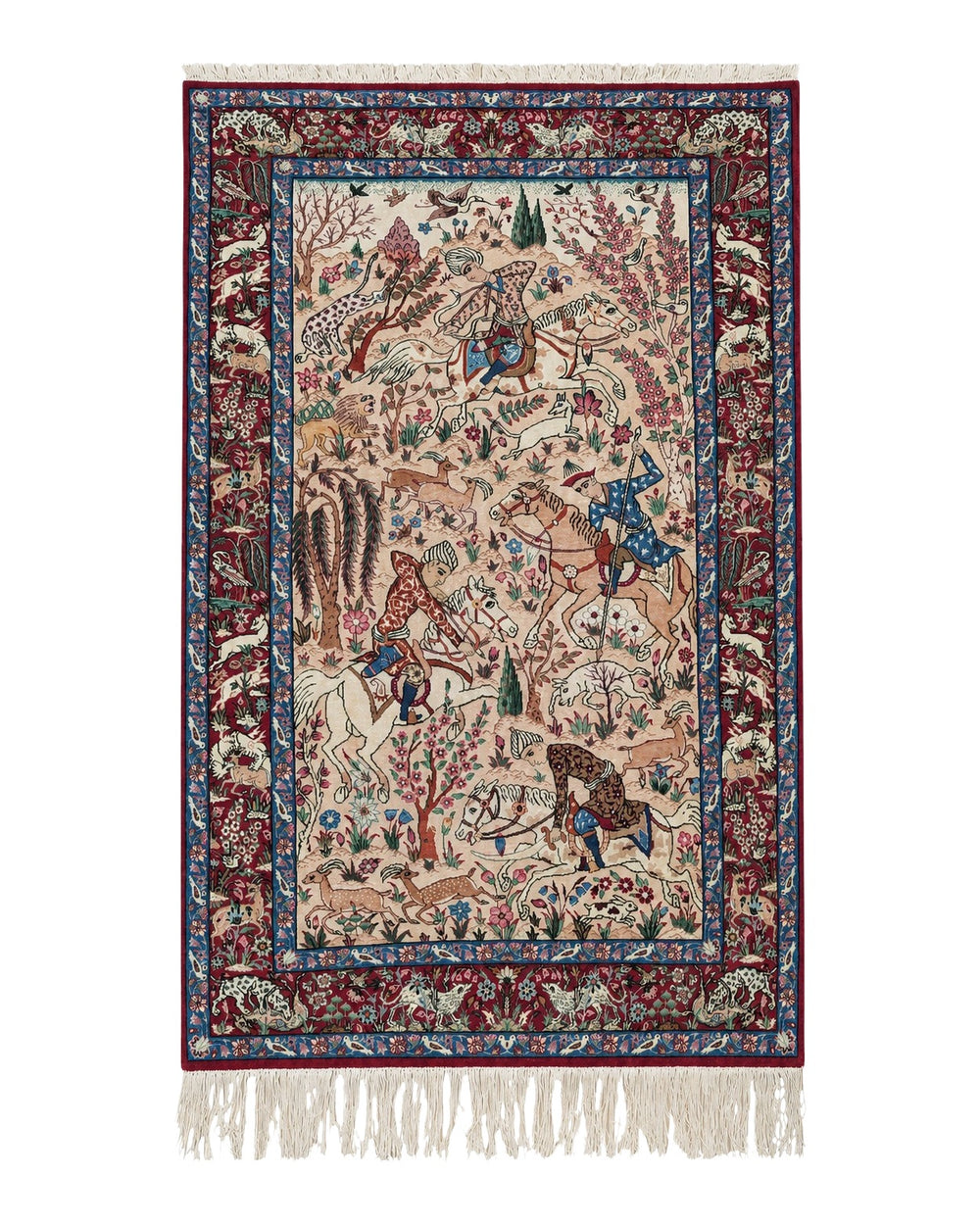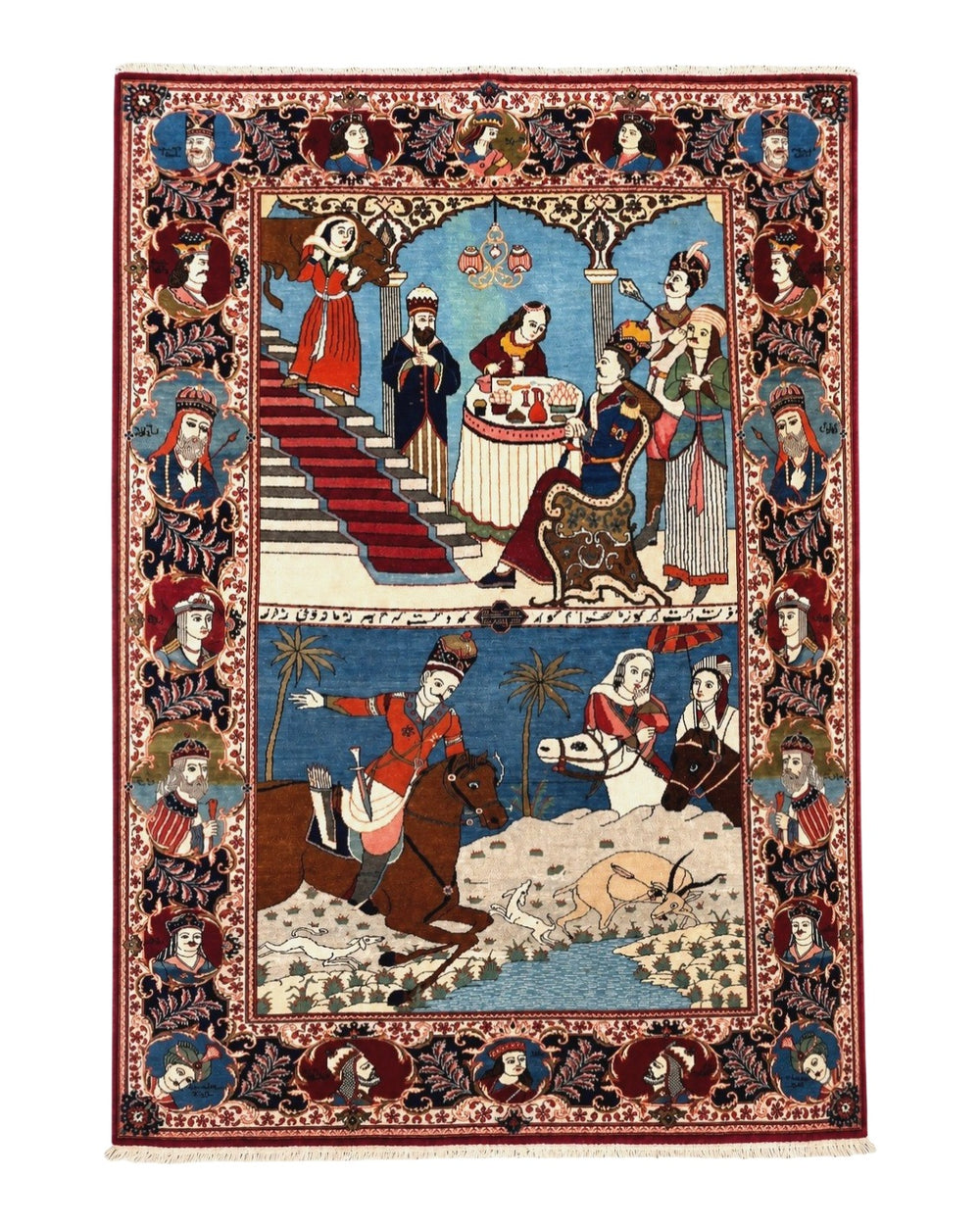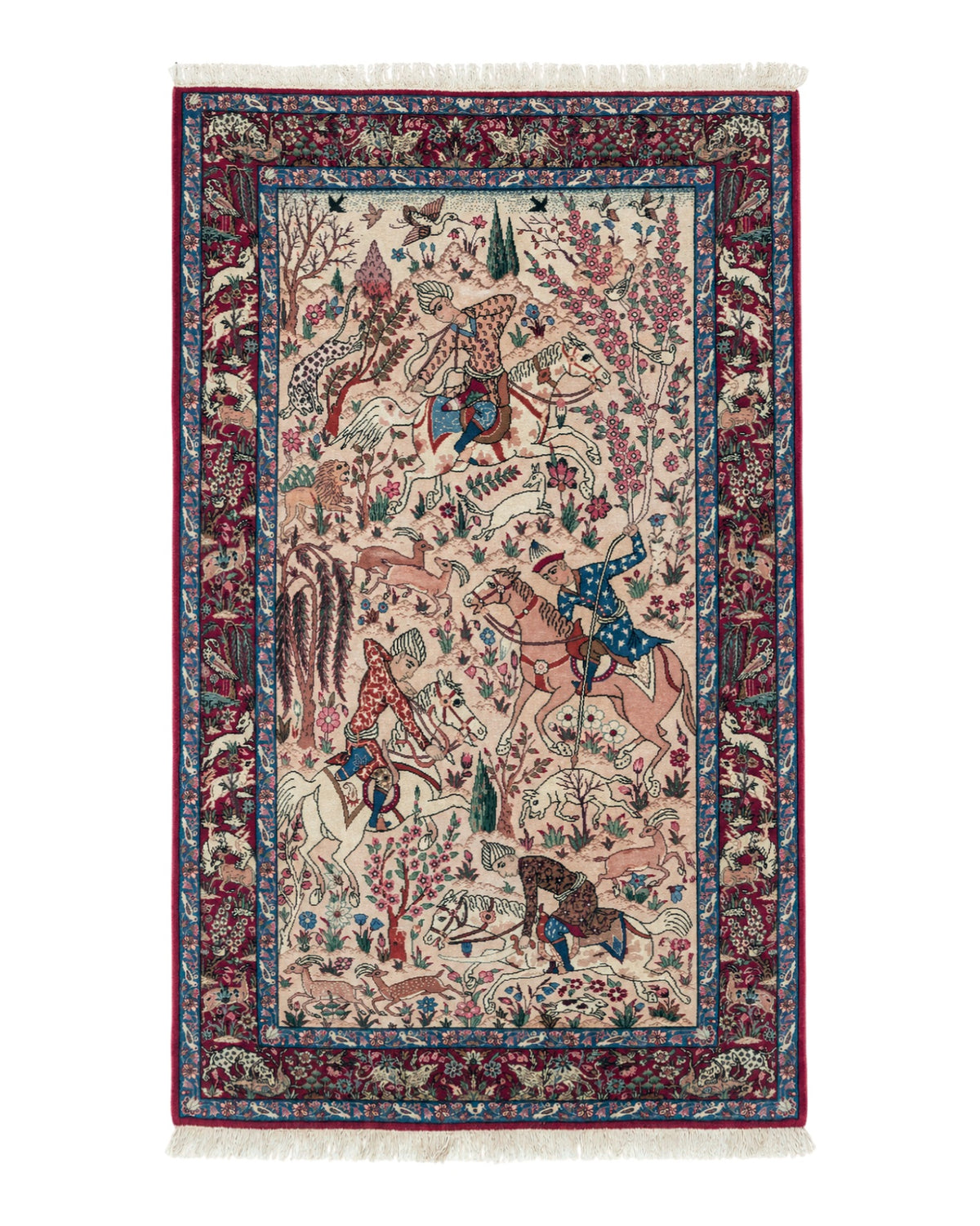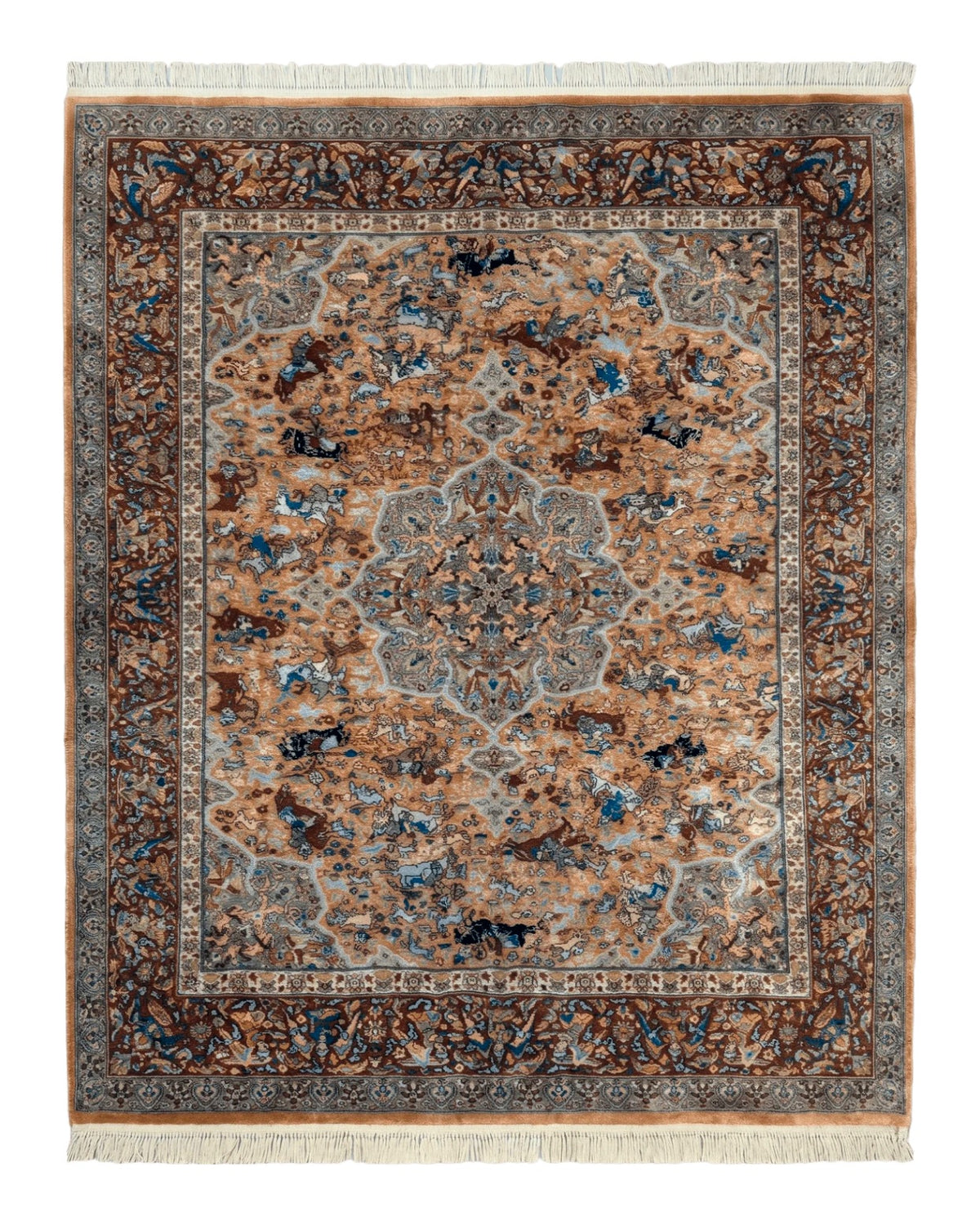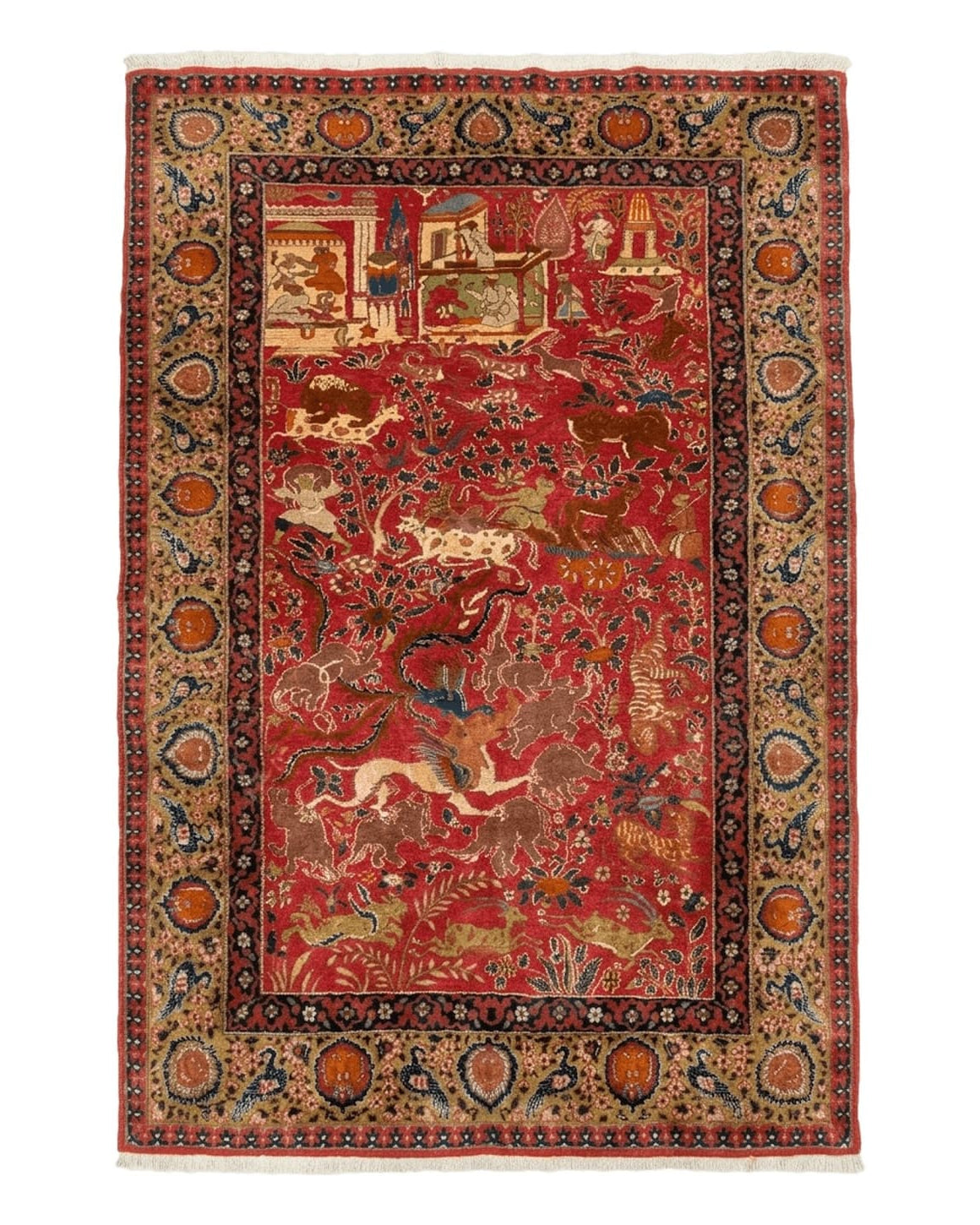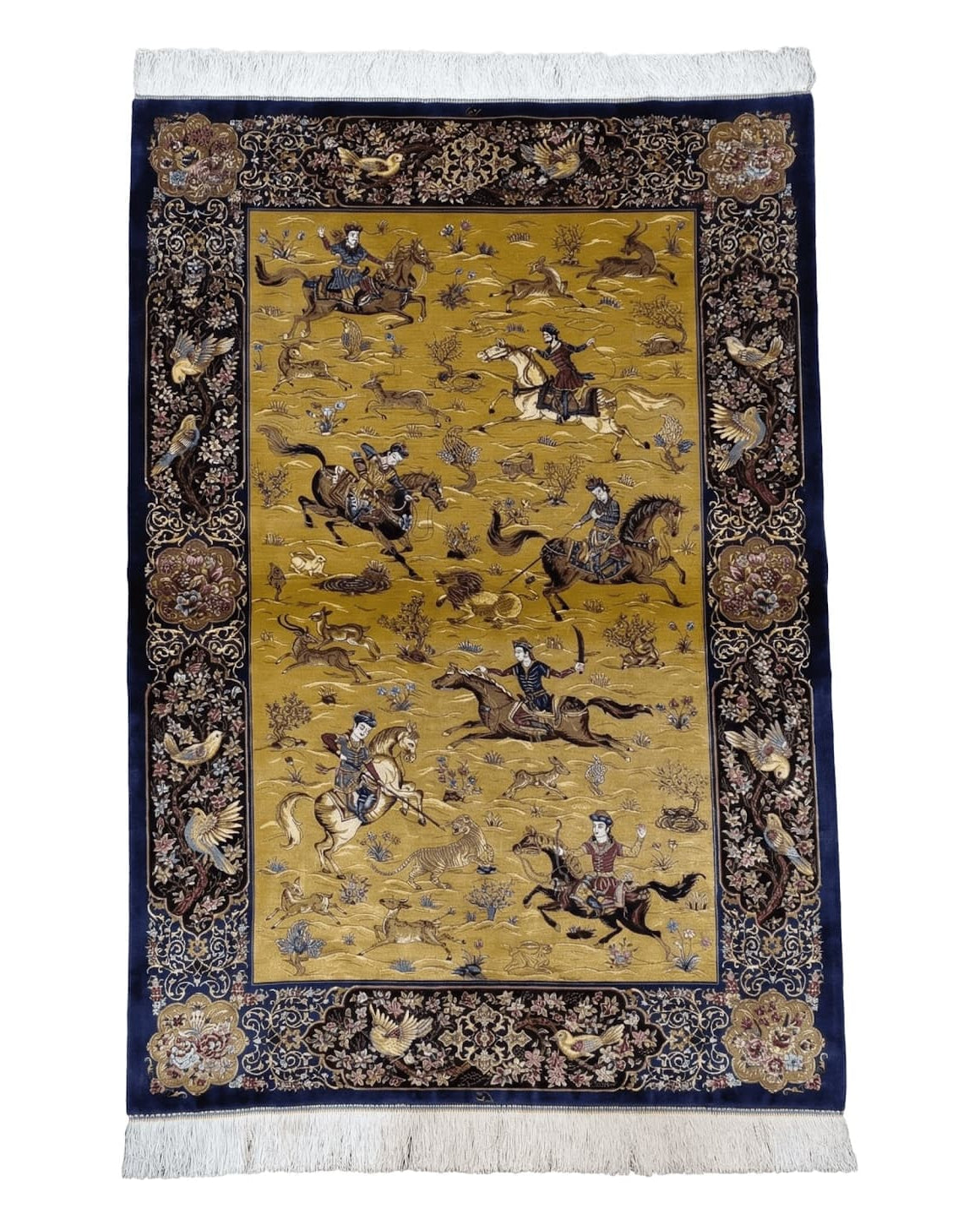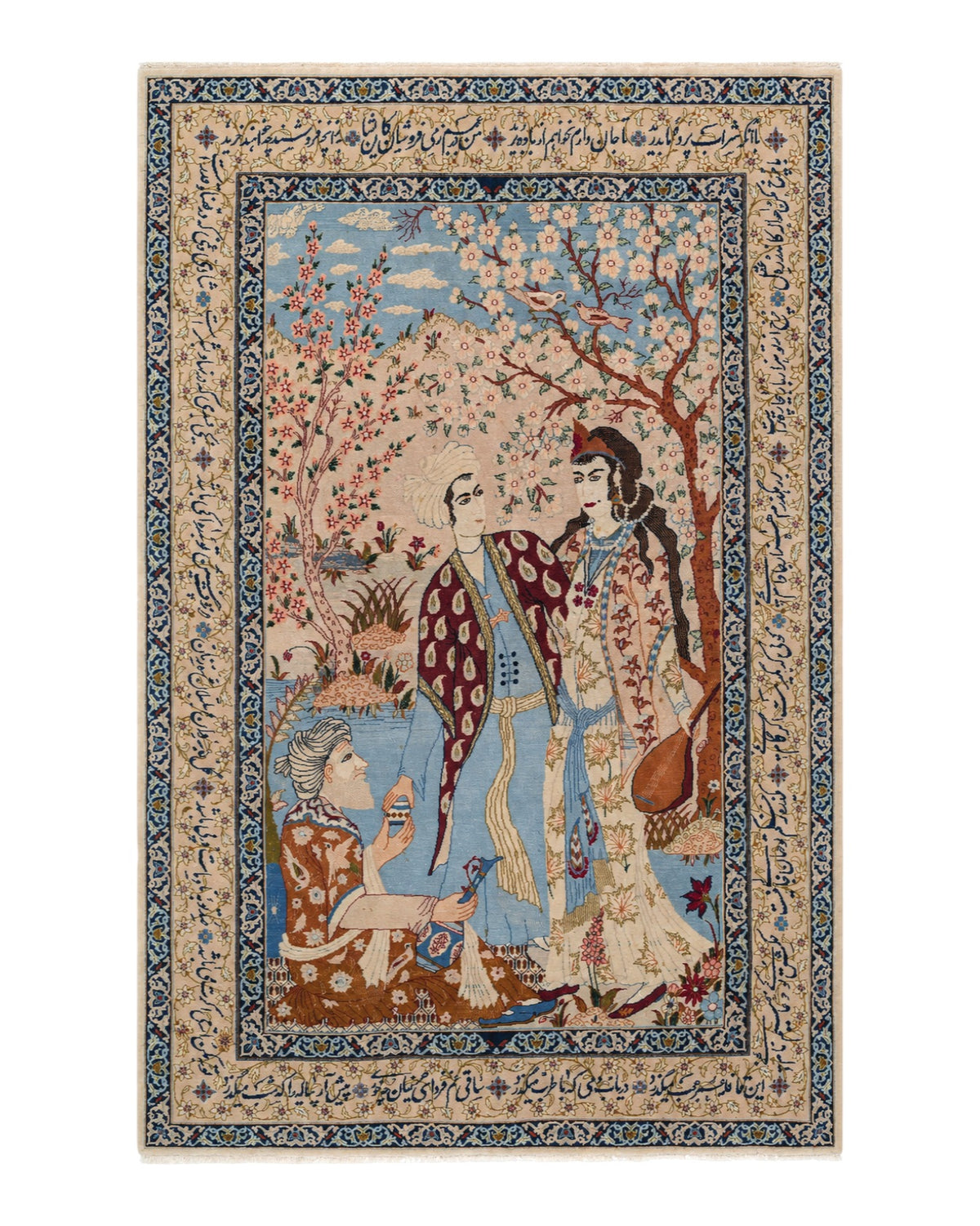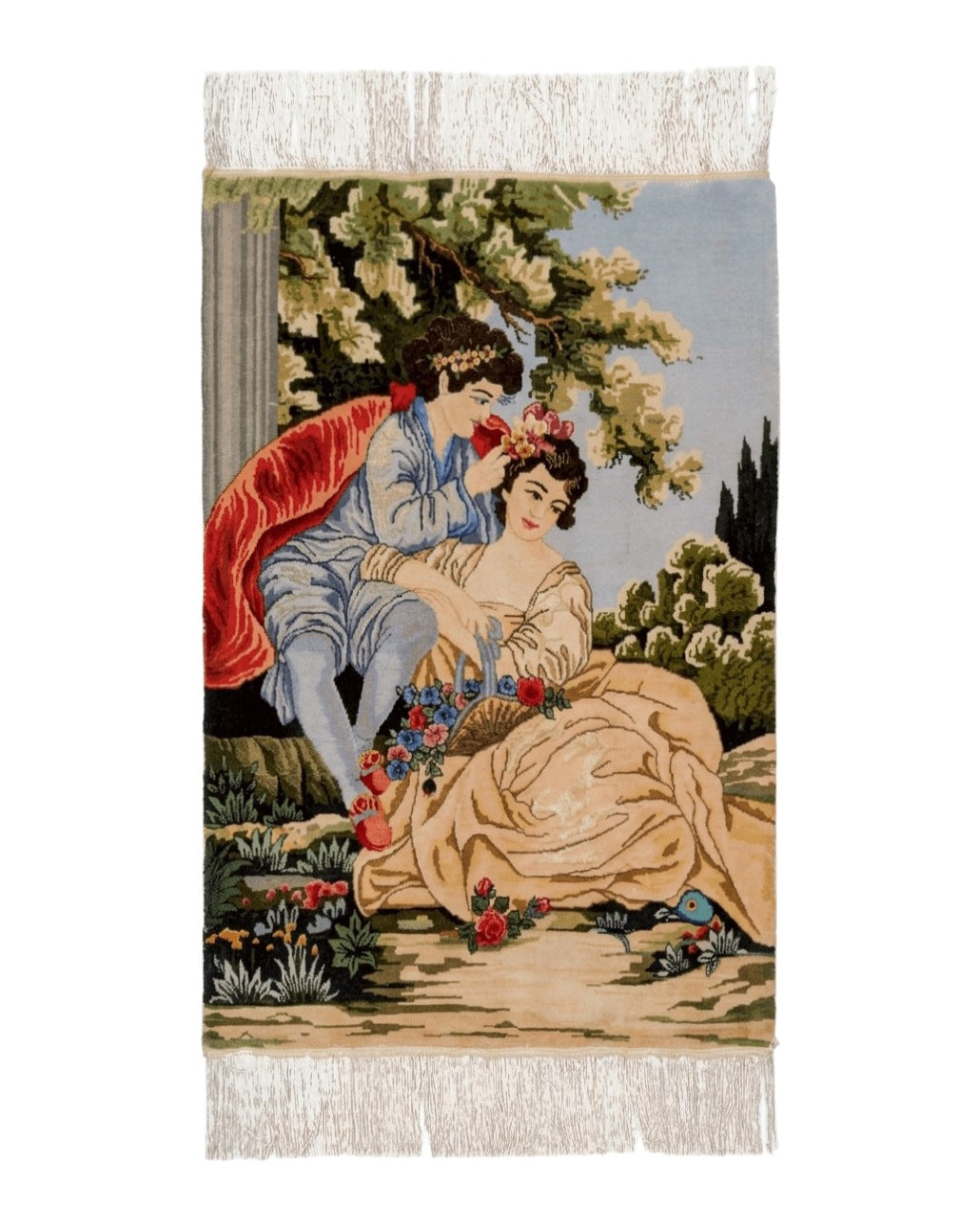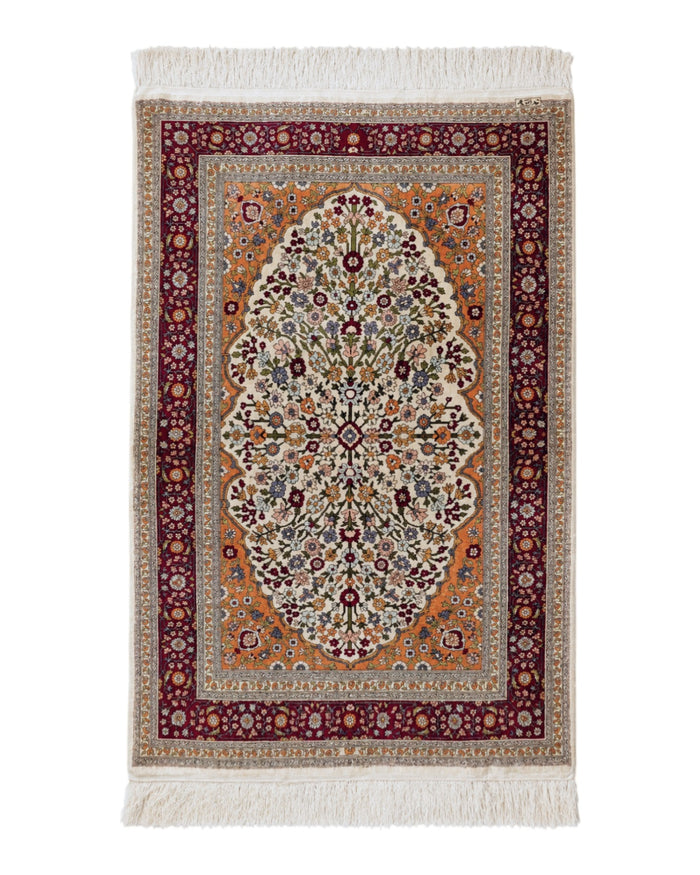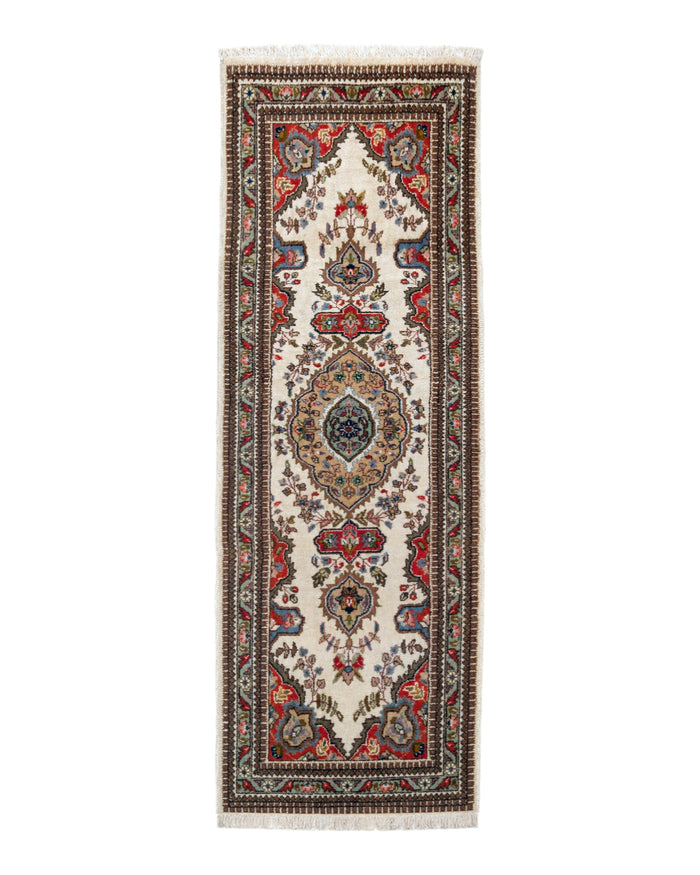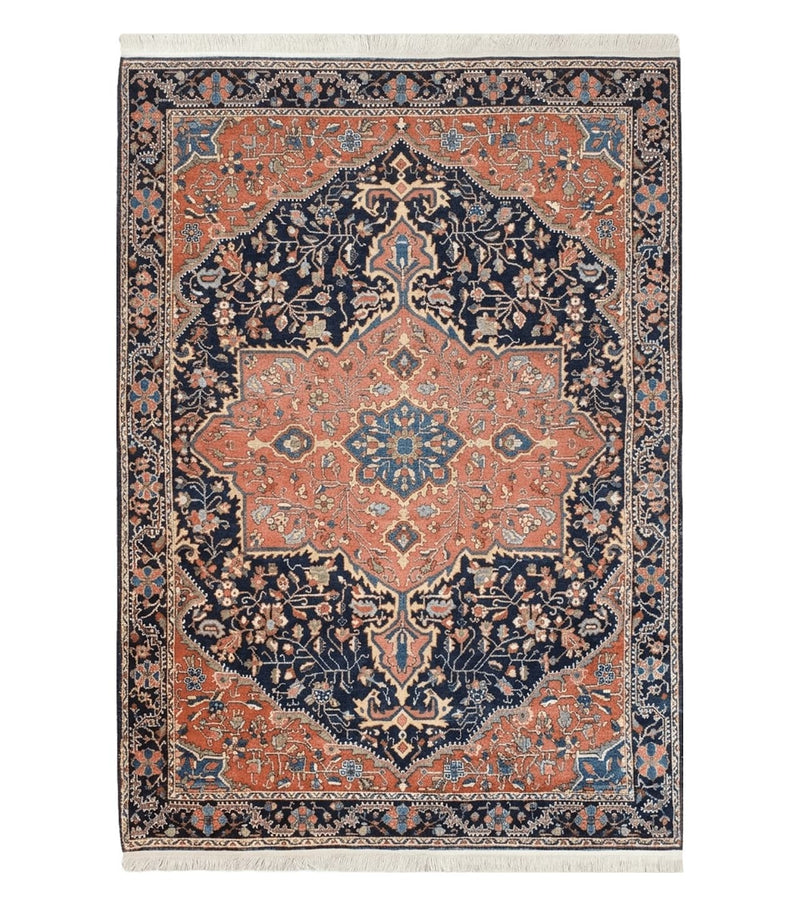


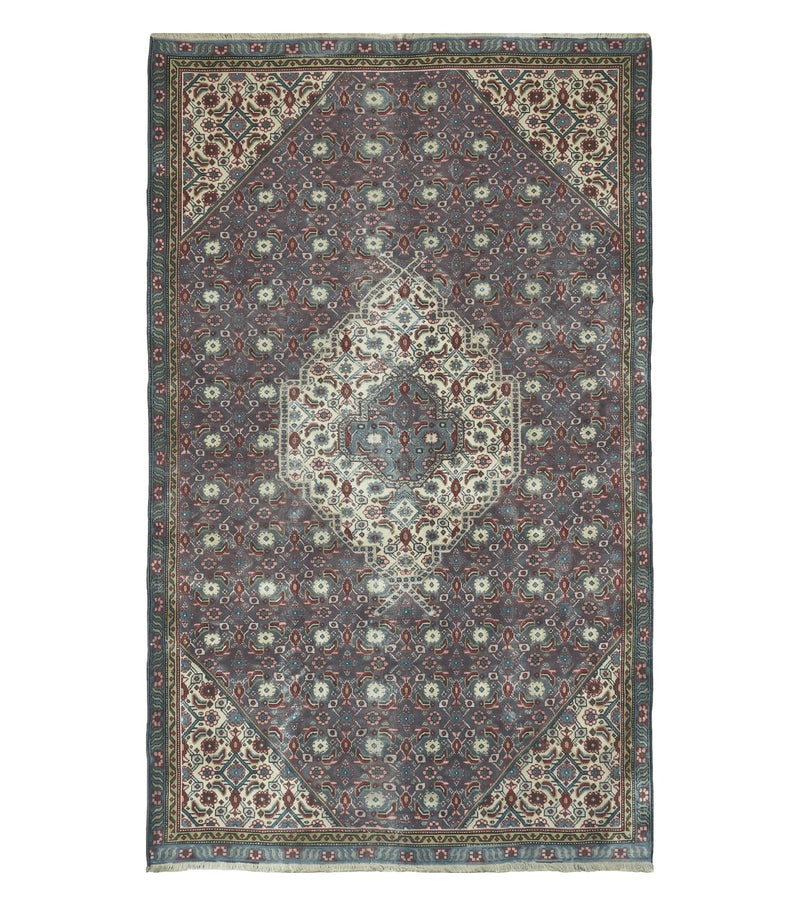


Most Persian rugs are decorated with patterns, but pictorial rugs show pictures: hunting scenes, stories from Persian poetry, kings and heroes, landscapes, buildings and portraits. They are among the most fascinating rugs to study, because every one tells a story. Many are woven very finely, in small sizes, and are meant to be hung on a wall like a painting, though larger pictorial and hunting rugs are made for floors too.
| Subjects | Hunts, poetry, history, religion, portraits, landscapes |
|---|---|
| Main centers | Tabriz, Isfahan, Kashan, Qum, Kerman, Kashmar |
| Knotting | Usually fine to very fine |
| Sizes | Often small, for hanging; some room-size hunting rugs |
| Often includes | Verses of poetry in the border, signatures |
Hunting rugs
The hunt was a favorite subject of Persian court art, and the hunting carpets of the Safavid period in the 16th century are among the most celebrated carpets ever woven. They show riders on horseback with bows, spears and swords pursuing lions, deer, gazelles and other animals across a field of flowers and trees. Later weavers revived the theme, and hunting designs are woven today in Tabriz, Qum, Isfahan and elsewhere, as well as in India and Pakistan.
Scenes from poetry
Persian poetry is a deep source of pictorial designs. Favorite subjects include:
- Layla and Majnun, the tragic lovers of Nizami's poem.
- Khosrow and Shirin, another of Nizami's romances.
- The Shahnameh, Ferdowsi's epic of kings and heroes such as Rostam.
- Omar Khayyam, often shown with wine and companions in a garden.
- Hafez and Saadi, whose verses are often woven into borders.
Many pictorial rugs carry lines of poetry in Persian script in small panels or cartouches in the border.
Portraits, history and landscapes
From the late 19th century, Tabriz and Kerman workshops in particular wove portraits of shahs, poets and historical figures, scenes from history, famous buildings, and copies of European paintings and photographs. Small pictorial rugs of village life, mothers and children, and young women with flowers are also popular. Kashmar weavers pack their pictorial rugs with figures, animals and plants. See Kashmar Rugs.
Where pictorial rugs are woven
- Tabriz: the leading center for portraits and story scenes, often very finely knotted.
- Isfahan: elegant scenes from poetry and history, often on a silk foundation and signed.
- Kashan and Qum: pictorial rugs in wool and silk.
- Kerman: portraits and historical scenes, especially in the early 20th century.
- Tribal weavers: simple, charming scenes of animals, riders and camps, and lion rugs.
Judging a pictorial rug
The best pictorial rugs show fine knotting, expressive faces and hands, careful shading, and a clear, well-composed scene. Faces are the hardest part to weave well, so they are a good guide to the skill of the workshop. A signature and a dated inscription add interest. See Signed Rugs.