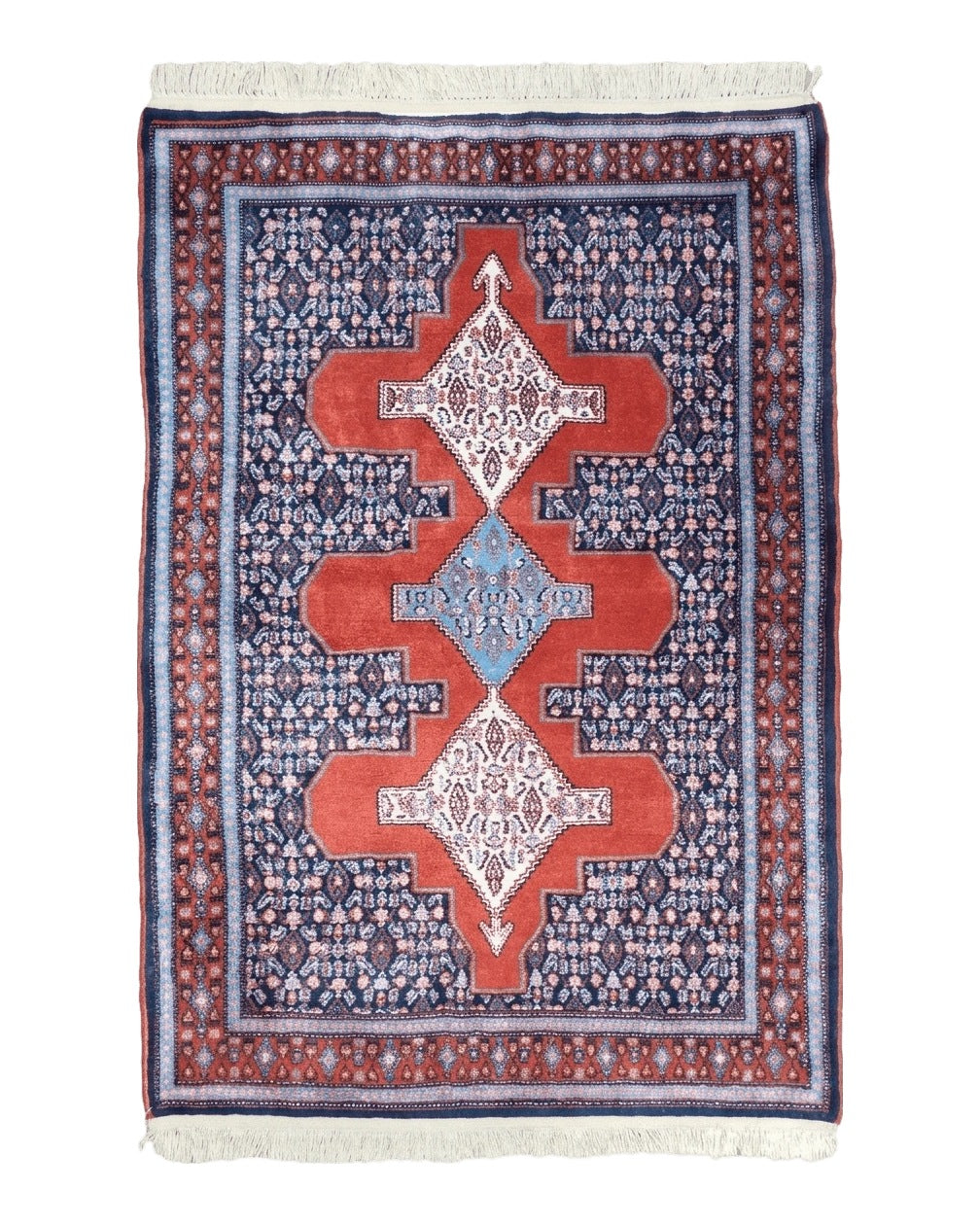
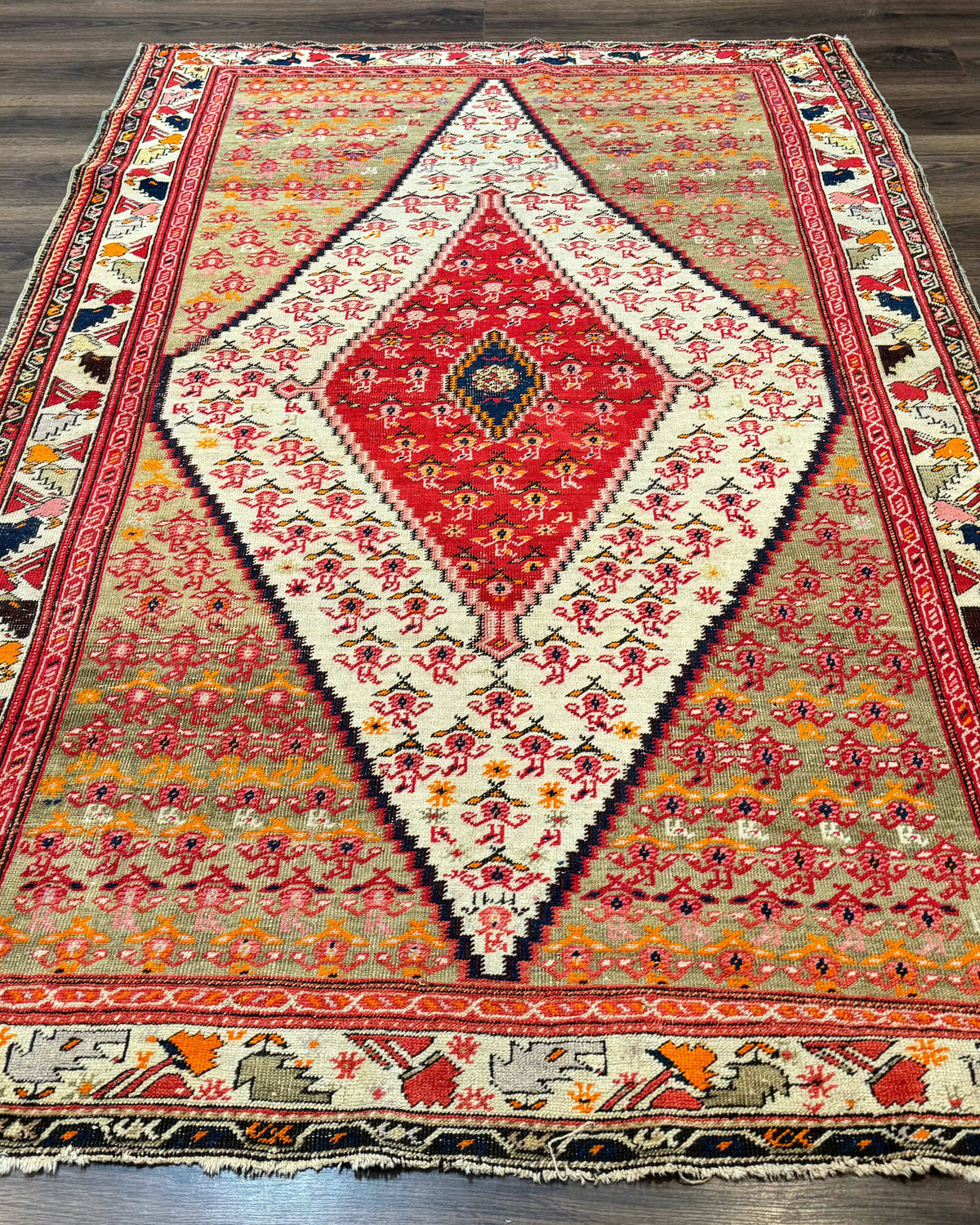
Senneh is the old name of Sanandaj, the capital of Kurdistan province in western Iran. Senneh rugs are among the most finely woven village rugs in Iran: thin, supple, with a very short pile and small, intricate designs. The town is equally famous for its kilims, which are some of the finest flatweaves made anywhere. Though Senneh is a Kurdish town, its rugs are refined rather than rustic, closer in spirit to city work than to most Kurdish weaving.
| Origin | Sanandaj (Senneh) and area, Kurdistan, western Iran |
|---|---|
| Tradition | Town and village rugs |
| Knot | Symmetric (Turkish), despite the name "Senneh knot" |
| Materials | Fine wool on a cotton foundation; sometimes silk warps |
| Construction | Single weft; thin, supple and finely knotted |
| Typical designs | Small all-over boteh and Herati patterns; diamond medallions |
| Also known for | Very fine kilims |
The Senneh knot puzzle
The asymmetric, or "Persian," knot is also called the Senneh knot, after the town. Yet Senneh rugs themselves are woven with the symmetric, or Turkish, knot. The name seems to have been given by early European writers, and it has stuck. See Knots and Knot Density.
Construction
Senneh rugs have a single weft between rows of knots and a very short-clipped pile, which makes them thin and flexible, almost like a heavy cloth. The back has a distinctive grainy, sandpaper-like feel. The knotting is fine, and the small motifs are drawn with great clarity. Because they are so thin, Senneh rugs are best used in rooms with light traffic.
Designs
The most typical Senneh design is an all-over pattern of small motifs: tiny boteh arranged in rows, or a fine-scale Herati pattern. Another classic layout is a diamond-shaped medallion, itself filled with the same small pattern, set on a field of the same or a contrasting pattern, with plain corner pieces. Colors include deep blue, red, ivory and soft yellow.
Senneh kilims
Senneh kilims are woven with extraordinarily fine wool wefts, so that their designs, often the same small boteh and Herati motifs found in the pile rugs, look almost painted. They are among the most collectible of all Persian flatweaves. See Kilim Rugs.
How to recognize a Senneh
- A thin, supple rug with a very short pile.
- A grainy back that feels like sandpaper.
- Small, precise all-over motifs, often boteh or Herati.
- A single weft between rows of symmetric knots.
See also Kurdish Rugs and The Boteh (Paisley) Motif.