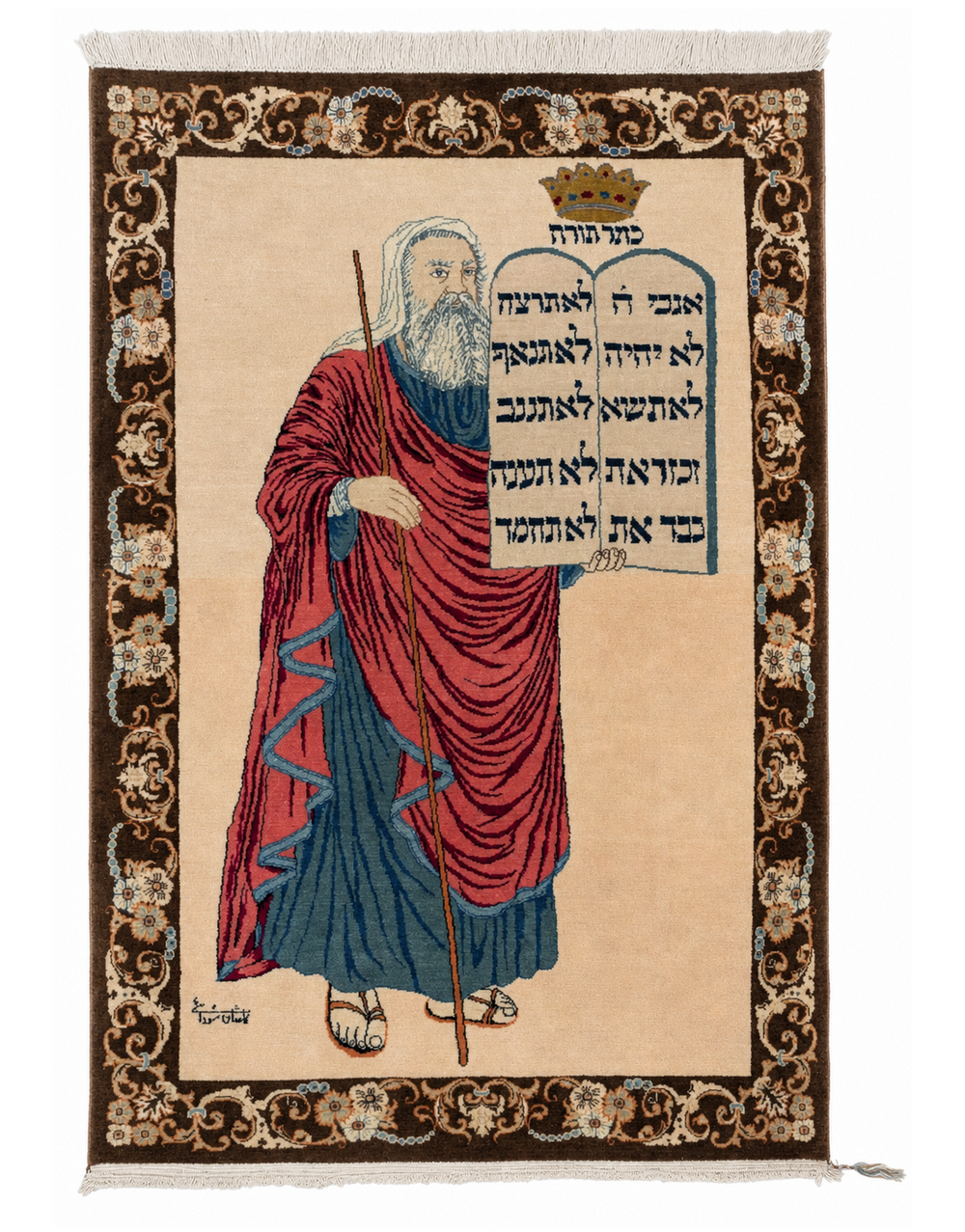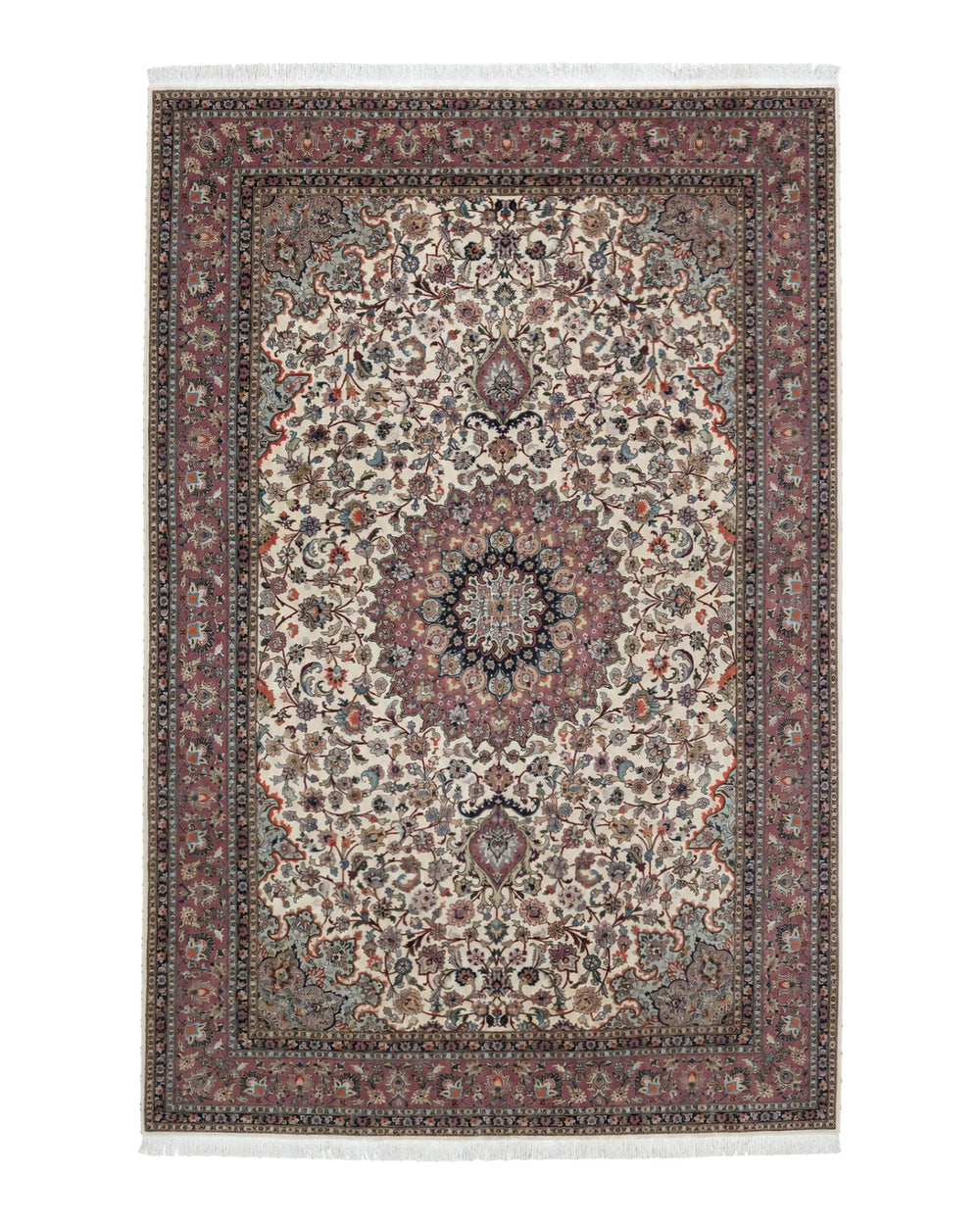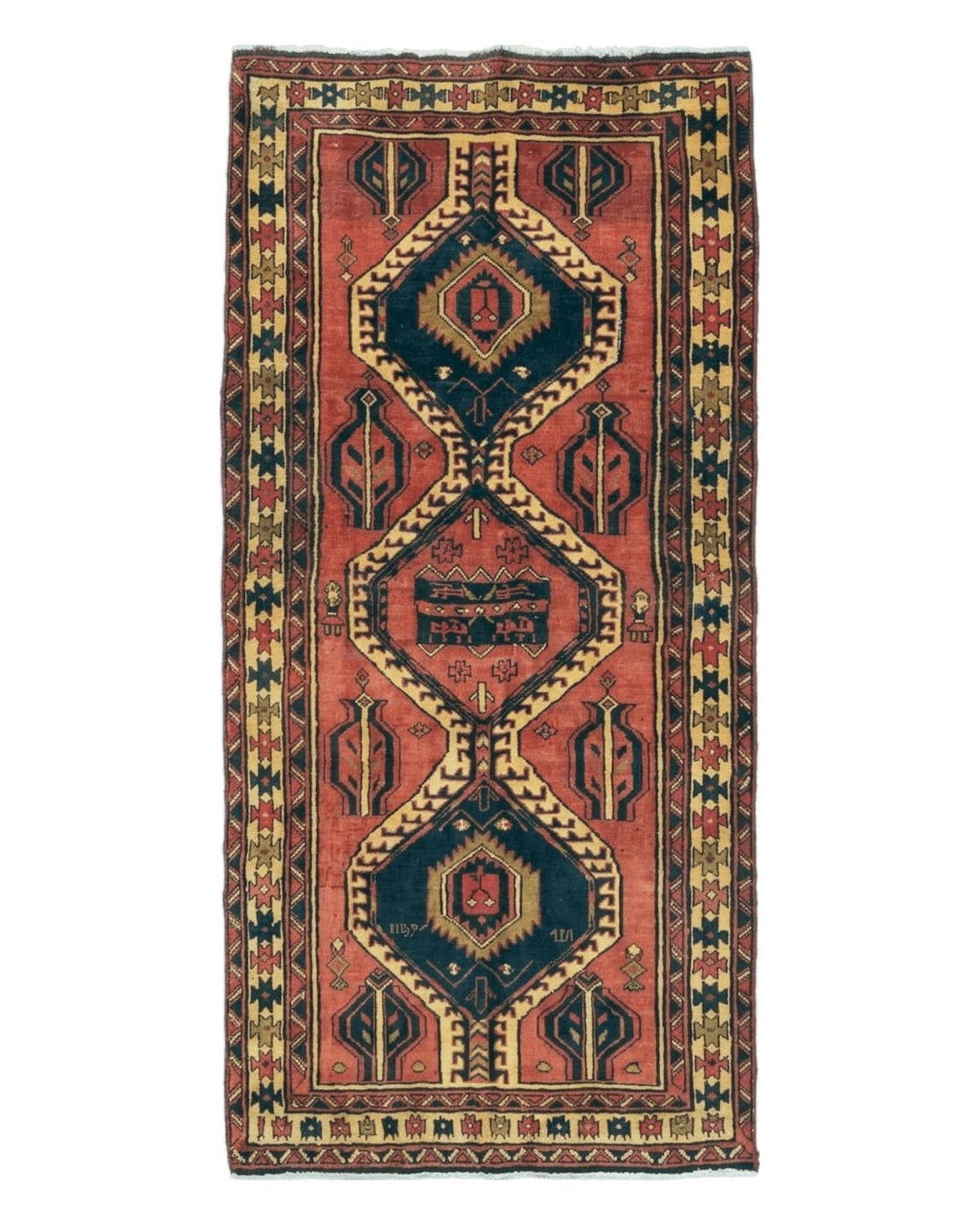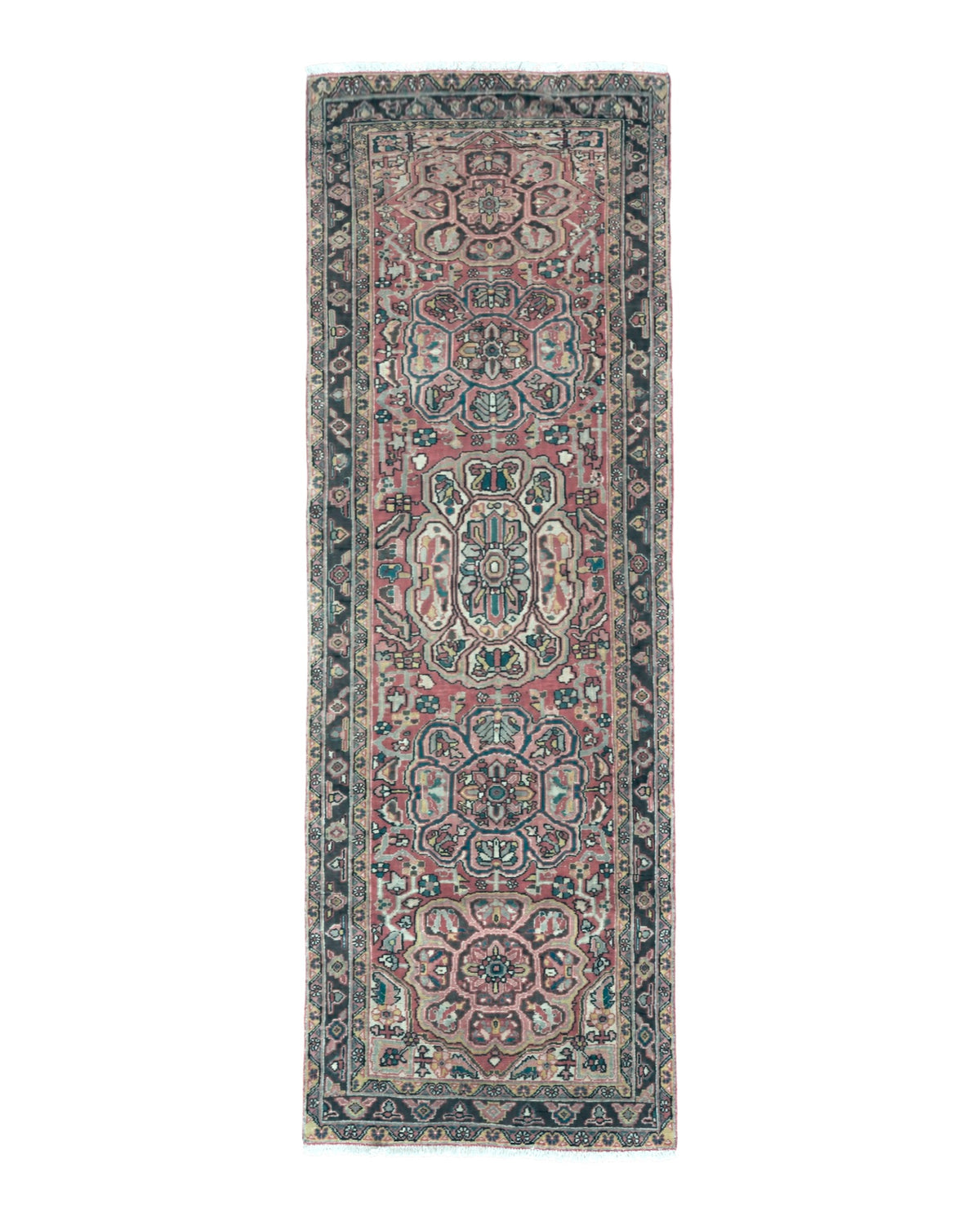




Every hand-knotted rug is built from thousands of individual knots, each one a short piece of yarn tied around the foundation threads and cut to form the pile. The type of knot a weaver uses is a clue to where a rug was made, and the number of knots in a given area, called knot density, tells you how fine and detailed it is. This entry explains both, and how to count knots yourself.
| Two main knots | Symmetric (Turkish or Ghiordes) and asymmetric (Persian or Senneh) |
|---|---|
| Knot density | Usually given in knots per square inch (KPSI) |
| Typical range | From under 80 KPSI on tribal rugs to 500+ on fine silk rugs |
| How to count | On the back: knots across one inch × rows in one inch |
| Metric equivalent | 1 KPSI ≈ 1,550 knots per square meter |
The two main knots
A knot is tied around a pair of neighboring warps, the threads that run the length of the rug. There are two main ways to do it:
- The symmetric knot, also called the Turkish or Ghiordes knot. The yarn wraps around both warps and both cut ends come up between them. It is used in Turkey and the Caucasus, and in north-west Iran by Turkic and Kurdish weavers, for example in Tabriz, Heriz, Hamadan and Bidjar.
- The asymmetric knot, also called the Persian or Senneh knot. The yarn wraps around one warp and passes behind the other, so one end comes up between the warps and the other comes up outside them. It can be tied open to the left or to the right. It is used in much of central and eastern Iran, for example in Kashan, Isfahan, Kerman and Sarouk, and in many Indian, Pakistani and Chinese rugs.
The asymmetric knot makes it slightly easier to weave very fine, curving detail, which is one reason it is common in fine city rugs. The symmetric knot gives a firm, even surface. Neither is better; each suits a different weaving tradition.
The jufti knot
A jufti ("paired") knot is tied around four warps instead of two. It halves the number of knots needed, so the rug is quicker to weave, but the pile is half as dense and wears faster. Jufti knotting is found especially in north-east Iran around Mashad, often mixed with ordinary knots in the same rug. It is hard to see from the front; on the back, each knot covers four warps instead of two.
What knot density means
Knot density is the number of knots in a given area, usually measured in knots per square inch (KPSI). More knots means smaller knots, finer yarn and more time at the loom, which allows sharper curves and finer detail. A rug with 300 KPSI has three times as many knots as one with 100 KPSI of the same size, and takes roughly three times as long to weave.
As a rough guide:
| KPSI | Description | Typical examples |
|---|---|---|
| Under 80 | Coarse | Many tribal rugs, Gabbeh |
| 80 to 150 | Medium | Many village rugs, such as Heriz and Hamadan |
| 150 to 300 | Fine | Many city rugs, such as Kashan and Tabriz |
| 300 to 500 | Very fine | Fine Tabriz, Isfahan and Nain |
| 500 and up | Exceptionally fine | Silk Qum and Hereke, the finest Isfahan |
These ranges overlap a great deal. Every type of rug is woven in more than one quality.
How to count knots
- Turn the rug over and find an area with a clear, simple pattern.
- Measure one inch across the width, along a row of knots, and count the small bumps. Each knot usually shows as two bumps, one for each warp it is tied around, so divide by two to get the knots across.
- Measure one inch along the length and count the rows of knots.
- Multiply the two numbers. For example, 12 knots across × 14 rows = 168 KPSI.
Count in two or three places and take the average, since knotting is rarely perfectly even. On some tightly woven rugs, one warp of each pair is pushed deeper than the other and only one bump per knot shows on the back; in that case, don't divide by two.
In metric terms, multiply KPSI by about 1,550 for knots per square meter.
On a coarse or irregular rug, counting a single inch can be misleading. Count across two inches in each direction instead and divide each count by two before multiplying, or average several counts taken in different places.
Raj: the Persian measure of fineness
In Iran, and especially in Tabriz, fineness is often given in raj (also written reg or rag): the number of knots across about 7 centimeters, or roughly 2.76 inches, counted in one direction. A "50 raj" Tabriz has about 50 knots across 7 centimeters. Because raj measures a line and KPSI measures an area, raj can't be converted by multiplying by a fixed number. First convert to knots per inch, then square the result:
KPSI ≈ (raj × 2.54 ÷ 7)², or more simply, KPSI ≈ raj² × 0.13.
For 50 raj: 50 × 2.54 ÷ 7 ≈ 18.1 knots per inch, and 18.1 × 18.1 ≈ 329 KPSI. See Tabriz Rugs.
| Raj | Approximate KPSI | Raj | Approximate KPSI |
|---|---|---|---|
| 20 | 53 | 50 | 329 |
| 25 | 82 | 55 | 398 |
| 30 | 118 | 60 | 474 |
| 35 | 161 | 70 | 645 |
| 40 | 211 | 80 | 843 |
| 45 | 267 | 100 | 1,317 |
These figures assume the same number of knots in both directions. Many rugs have more rows than knots across, or the reverse, so counting both directions on the back gives a more reliable figure than the table.
What knot density doesn't tell you
Knot density is a measure of fineness, not of quality on its own. A coarsely knotted village rug with excellent wool and natural dyes can be more beautiful, more durable and more valuable than a finely knotted rug made with poor materials. Coarser rugs often have a thicker pile and stand up better to heavy use.
When judging a rug, consider density alongside the quality of the wool, the colors, the design and the condition. What Determines a Rug's Value explains how these fit together.